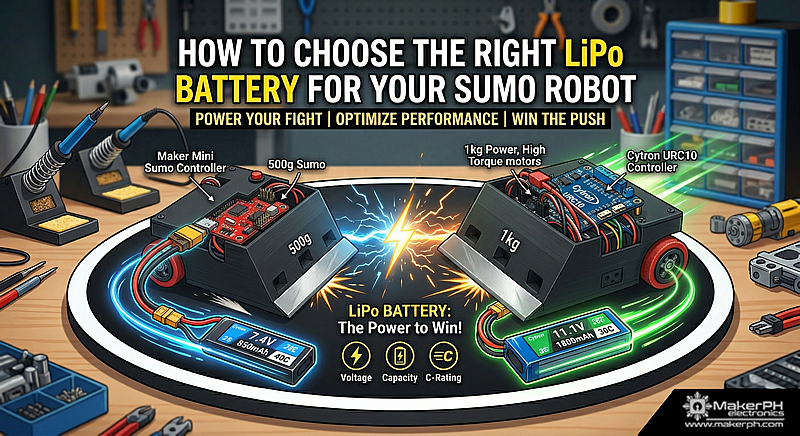
How to Choose the Right LiPo Battery for Your Sumo Robot
When building a sumo robot, every component matters — but nothing affects performance as heavily as the battery. You can have powerful motors, excellent sensors, and great coding, but if your battery cannot deliver stable and sufficient current, your robot will lose torque, stall under load, or even damage its electronics.
Choosing the right LiPo (Lithium Polymer) battery ensures strong pushing power, consistent motor output, and reliable operation throughout each match. This guide explains how to pick the correct LiPo battery for your sumo robot, why C-rating matters, and how to match your battery with controllers like the Cytron URC10 and Maker Mini Sumo Controller.
🔋 Understanding LiPo Battery Basics
A typical LiPo battery label looks like this: 7.4V 1800mAh 30C
- Voltage (V): LiPo cells are 3.7V each.
- 1S = 3.7V
- 2S = 7.4V
- 3S = 11.1V
- Capacity (mAh): Capacity determines how long your robot can run. 1800mAh (1.8Ah) can supply 1.8A for 1 hour. In Sumo, prioritize current delivery and weight over massive capacity.
- C-Rating (Discharge Rate): This determines how fast the battery can safely release current.
Example: 1.8Ah × 30C = 54A max continuous output.
⚡ Why C-Rating Is Extremely Important
🧨 If the C-rating is too low:
Your robot may experience torque loss, slower pushing power, or motor driver brownouts. If the battery can’t keep up, your voltage drops exactly when you need the most power—during a push.
💸 If the C-rating is too high (overkill 100C+):
High C isn’t dangerous, but it offers no performance gain for brushed DC motors. It usually adds unnecessary weight, extra cost, and a larger physical footprint.
Ideal C-rating: Choose a battery with a C-rating 20–30% higher than your robot’s actual stall current requirement.
⚙️ Matching Battery, Motors, and Controller
| Spec | Maker Mini Sumo (500g) | Standard Sumo (1kg) |
|---|---|---|
| Controller | Maker Mini Sumo Controller | Cytron URC10 |
| Voltage | 2S (7.4V) | 2S or 3S (7.4V–11.1V) |
| Motor Type | 6–9V DC Gear Motors | High Torque 12V Motors |
| Rec. Battery | 2S 600–1000mAh 30–50C | 2S–3S 1500–2200mAh 30–60C |
🔌 Connectors and Wiring
Choosing the right plug is vital for high-current delivery:
- Dean / T-Plug: Compact and common in 500g Mini Sumo. Rated for ~50A.
- XT30: The modern favorite for Mini Sumo; very secure and small.
- XT60: The standard for 1kg+ Standard Sumo requiring high current.
💡 Note: Avoid using thin “breadboard” style jumper wires for your main power lines. They cause massive voltage drops and can melt under stall conditions.
🔥 LiPo Safety Guidelines
- Balance Charge: Always use a dedicated LiPo balance charger.
- Storage Charge: If not using for >2 days, store at 3.8V per cell.
- Low Voltage: Never let a cell drop below 3.2V.
- Physical Check: If the battery looks “puffy” or swollen, stop using it immediately.
⚡ Final Thoughts
The best battery isn’t the biggest one—it’s the one that fits your weight limit while providing enough “burst” current to win the push. For MakerPH builders, a 2S 850mAh 40C is the “sweet spot” for most Mini Sumo builds.
Ready to power up? Check out our LiPo batteries at the MakerPH shop!